Our other postcard from Bali — What a night!

We really wanted the fullest possible Balinese experience, and our ship overnighted there. So instead of four two-hour bus trips back and forth from the port to the areas of interest we rented a Balinese villa in a resort for the night. Then we organized a guide to take us to the villa with guiding along the way, and back to the ship with more guiding the next day. That also gave us the opportunity to have the conversations we shared in our other Bali postcard.

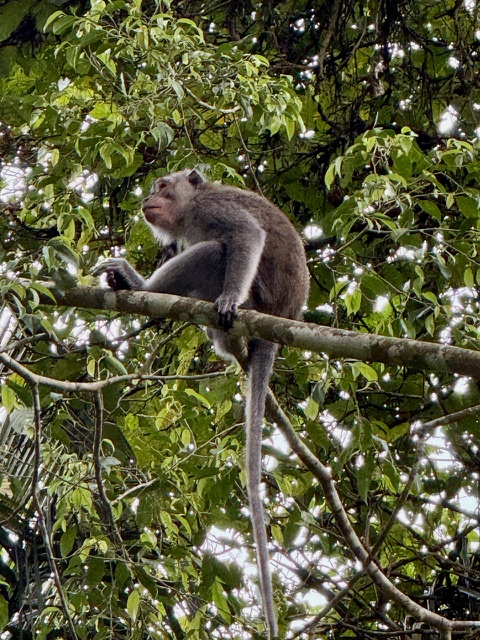
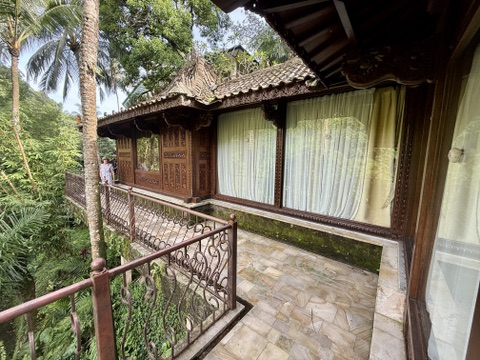
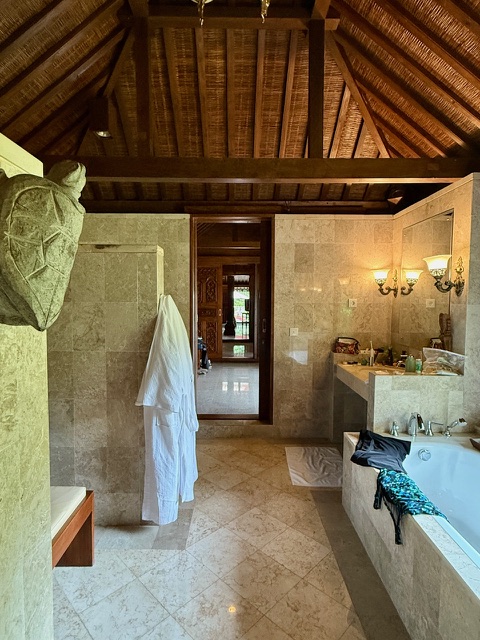
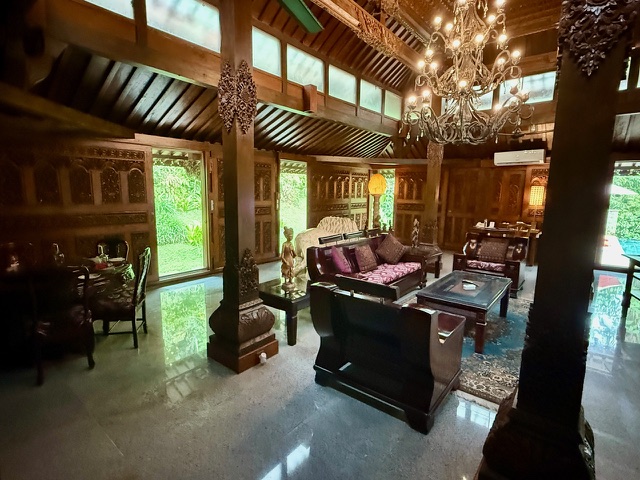
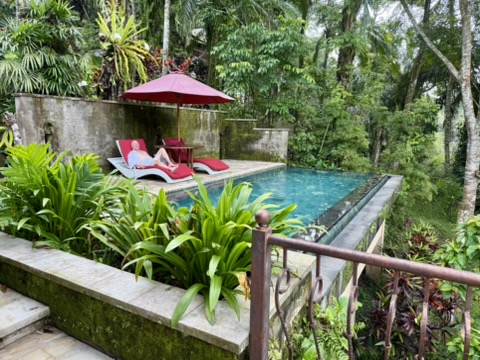
Our Royal Villa was located in a resort carved into the jungle in Ubud, very authentic, and quite a find. Four expansive rooms totaling 1800 square feet, all carved wood, totally private and with its own swimming pool. As we lounged by the pool upon arrival monkeys were moving around in the trees 40 feet away. They never bothered us.
We were offered a four course romantic dinner for two when we booked. Always game for romance we said yes, not really knowing what to expect. Wow! They led us through the dining room and past tables for two on a balcony with amazing views out over the jungle. We were already thinking “good move” when we saw those tables. Then they led us up another stairway to a private patio where we found this — just for us.
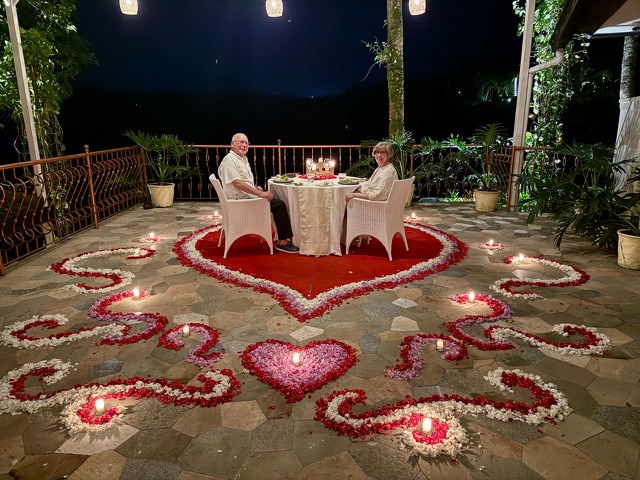
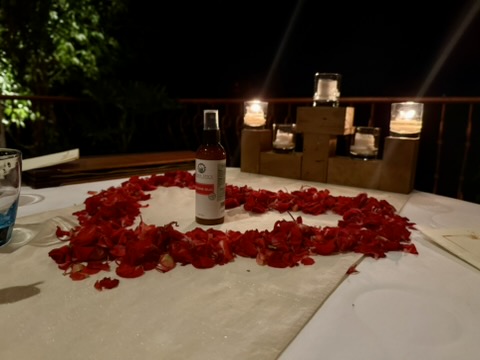
The floor and table decorations are fresh flower petals in red, pink and white – thousands of them. We asked how long it took to set up? After buying the flower petals already individually “plucked” it took two people 4 1/2 hours to arrange this. Probably obvious that this was a very special dinner.

At this point you might be thinking that we were being pretty extravagant. It seems like it when dealing with the local currency. The Royal Villa, including all fees and an expansive breakfast, was over 6 million IDR (local currency). That translates to only $340 USD. The romantic dinner for two, including all of the flowers plus cocktails and wine was $146 USD. The memories — priceless!

This is the fifth time we have “booked a room” when we already had a cruise ship cabin. Each time the experience became a cherished memory. The place we booked, the dinner and then watching things around us peacefully go to sleep — and slowly wake up the next morning all became an extra dimension and connection.

By the way, Patrick and Terry did something similar on their visit to Bali last year. We had fun comparing notes, and his suggestions were very helpful.
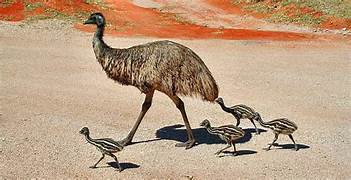
Our postcard from South Australia — Launching kangaroos and emus

In the spirit of things that intrigue us …

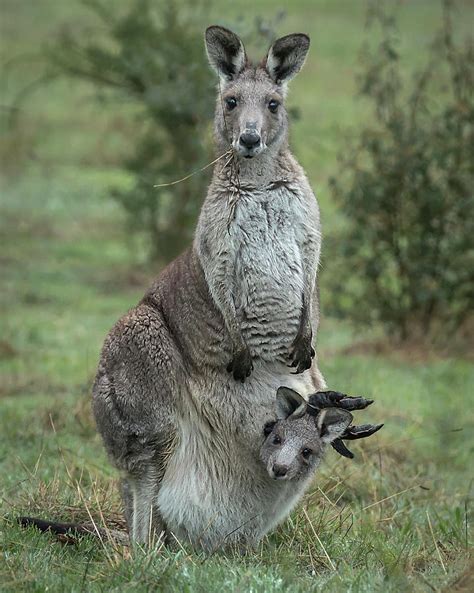
Kangaroos grow to the size of a human, yet at birth they are the size of a grape. They somehow crawl from the birth canal up the fur of their mother, drop into the pouch and attach themselves to a teat. After several months they may venture briefly outside of the pouch — but it will remain their bed for 6 – 8 months. And they are always called joeys as babies.

But wait, there is more! They are so small birth must not hurt, and the process of giving birth is apparently an aphrodisiac — so the new mom immediately looks for a mate to create another one. There are actually four teats in her pouch, so plenty of capacity. A second joey can quickly come along, while the first one moves over to a larger teat. Then perhaps a third. The largest teat is used by a joey no longer living in the pouch yet still needing nourishment.

There are 45 million kangaroos in Australia, vs. 25 million humans. Guess it works!

Emus are quite a different story, and very much a women’s liberation one. As adults they are also the size of humans, yet they begin their journey as large eggs. During mating the females thump their legs against their chest to signal that they are “in the mood”, and the males plume their feathers and dutifully follow the females around to compete to be the chosen one.

The female chooses and prepares the nesting site. Once she lays the eggs she wanders off to find her next mate, never looking back. The male dutifully remains on the eggs 24/7, not even leaving for food or water for himself throughout the 56-day incubation period. After the eggs hatch, the male takes on the crucial role of caring for and protecting the adorable baby emus. The chicks are covered in soft downy feathers and are remarkably independent from hatching, capable of walking and following their father within hours.

The father does not feed them. Rather they learn from the outset by observation to feed themselves. They become more independent after 6 – 8 months, yet the family roots remain strong throughout their lives. Presumably “dad” is available for a repeat after 12 – 18 months.

Our winery visit guide shared this info with us. Who knew?

First postcard from our trip spanning Melbourne to Tokyo

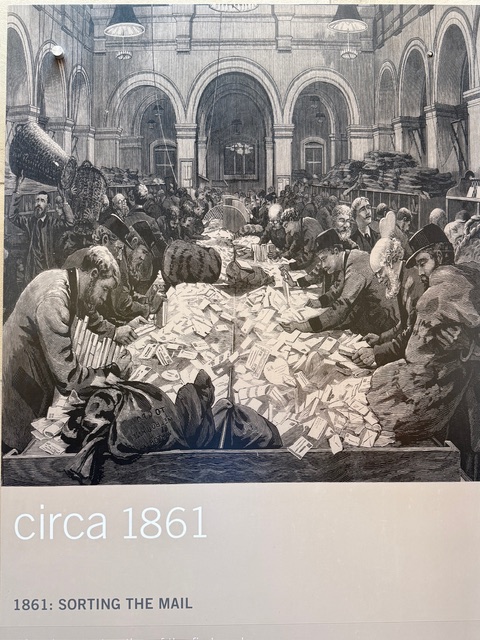
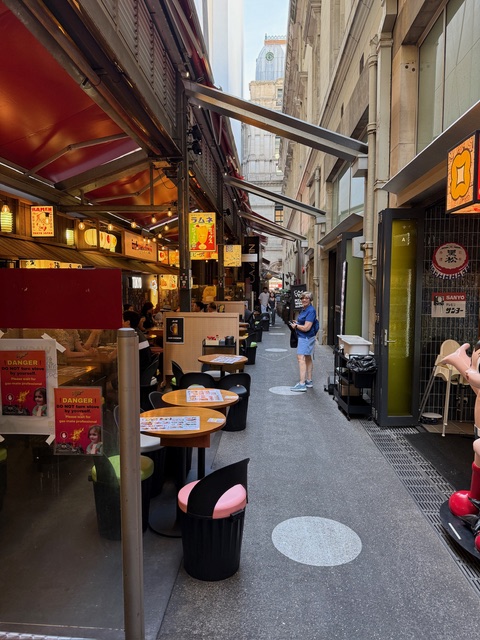
Ever wonder how mail was sorted before all the big and fast machines? Neither had we, until we saw this photo in Postal Lane in the center of Melbourne.

We learned that as Melbourne grew rapidly in the 1800’s the number of postal sorters grew from three to dozens to 2,500. They were housed in a small street linked to the central post office that was covered to create a workspace. A common practice to support the growth. By the mid-1850’s there were 80 named lanes, dedicated to a variety of uses.

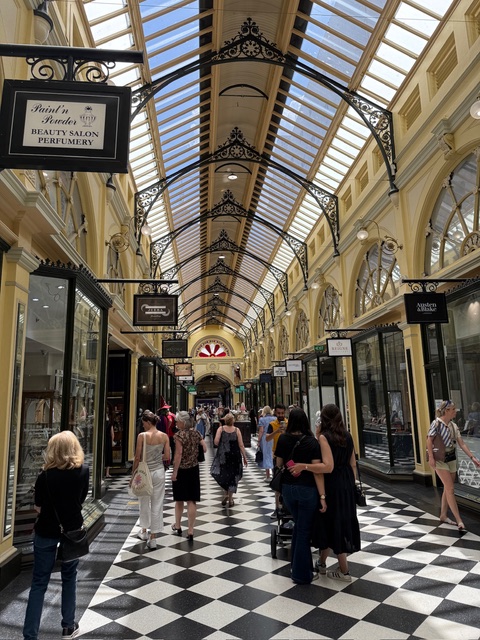
Today these lanes, alleyways and arcades (the covered ones) are a huge part of Melbourne’s shopping and dining charm. Winding through them is one of the things we love about being here for the third time (actually Jim spent six months here leading a consulting team 30 years ago). Today Postal Lane is mostly food. It is quite modest by comparison to many others, yet helped shape the trend then and now.

Like so much of Melbourne, these lanes and alleyways have been amazingly well preserved. They are all now covered by heritage status, which is widespread here and strongly protected.

Royal Lane, completed over 150 years ago in 1869, is the standard bearer for shopping.