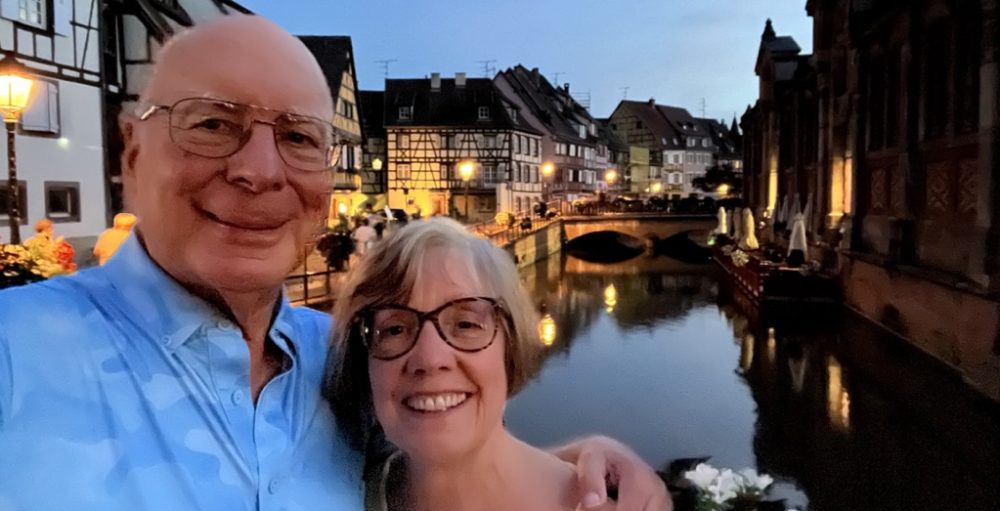
Our final postcard — from Santiago de Compostela

The Cathedral of Santiago de Compostela is the destination for the Pilgrims from all of the various paths in Europe. Some walk maybe 30 miles, and others hundreds. In addition to some amazingly reflective time on the trails they receive forgiveness for their sins upon completion. The emotions displayed by those just completing their pilgrimage were palpable. I wish I could have captured them in a photo — but that felt like an invasion of privacy. They made so many sacrifices for that moment.

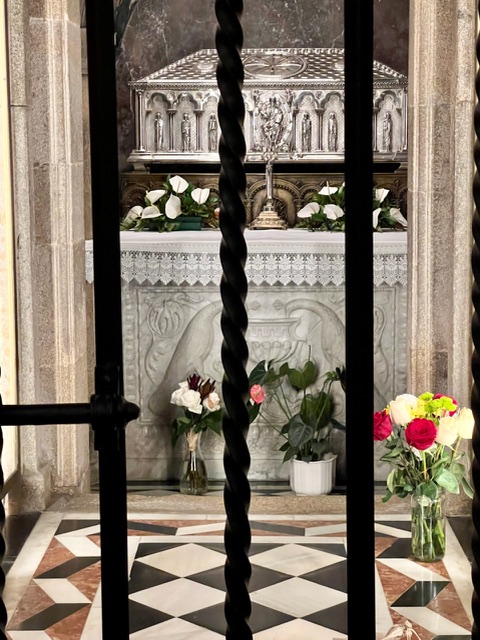
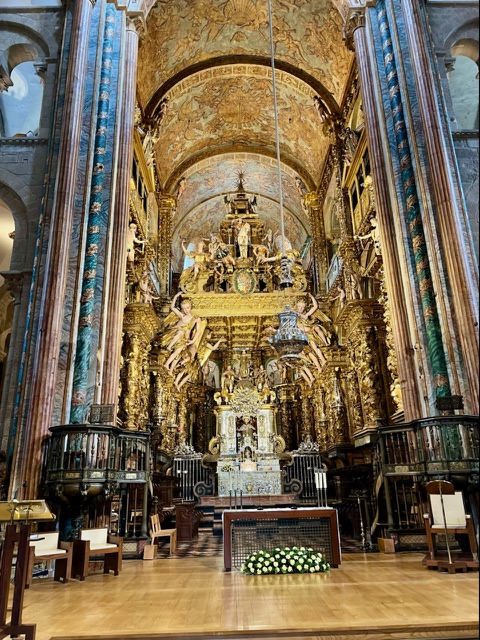
We found that we were very lucky regarding timing. Going through a special door that leads directly to the tomb of Saint James also provides a pardon of all sins. But it is only open every 7 – 10 years, and was open when we visited. The first picture is the tomb of Saint James. The second is the amazingly detailed nave of the Cathedral. I do not recall seeing another so ornate.

This concludes our Postcard from series. Our goal was to share things that either intrigued us or inspired us. Many of you have commented on various postcards, which we appreciate. We hope you enjoyed them — and thanks for listening.

We made it safely home on Wednesday, October 12. Thanks to a lot of washing hands and still wearing our masks whenever in a crowd, even on the ship, we remained healthy. Not even a cold. Six flights, with no delays, no baggage adventures (even our wine suitcase made it unscathed) and good flying weather for all trips. And over seven weeks during the Europe transition from summer to fall we only needed an umbrella while out and about for a total of 2 1/2 hours. Rain was forecasted for a number of days, then the clouds departed and the sun came out instead.

This was a wonderful trip. So many great experiences — about people, the beauty of our world and history. Hard to believe, yet over seven weeks we visited 15 countries. Some of them twice. All of the Continental Europe Nordic countries (Sweden, Denmark, Norway, Finland). All three Baltic countries (Lithuania, Estonia and Latvia). Germany, Belgium and the Netherlands (twice). Then the UK, Ireland, France, Spain and Portugal.
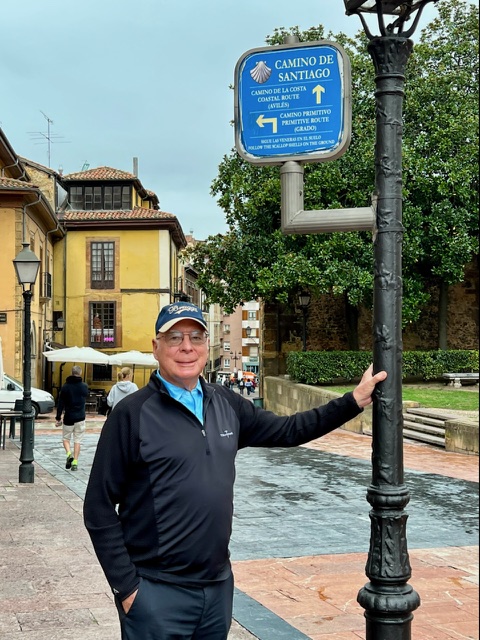
Our postcard from the Camino de Santiago — Following the shells

We have heard about the Camino de Santiago – the pilgrimage many make each year to the Cathedral of Santiago de Compostela. There are several routes. On a previous trip we found ourselves in Saint-Jean-Pied-de-Port France, watching the pilgrims register for the 40 + day journey and reserve their place in the hostels by hanging their backpack on the door.

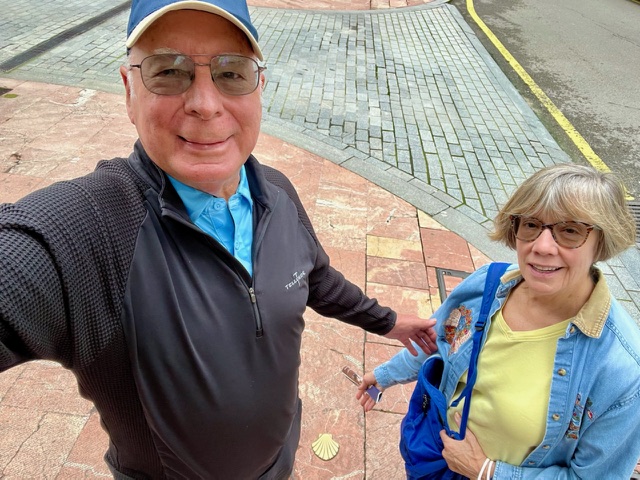
Oviedo is where the first pilgrimage began in the 9th century, shortly after the discovery of the tomb of Saint James the Apostle and because of the devotion of King Alfonso II. He made the first pilgrimage. Knowing that we would be in Oviedo motivated us to at least try a small bit of the pilgrimage. The starting point is the Cathedral of Oviedo. Bronze shells mark the path, and we followed those shells for almost an hour through Oviedo. While clearly not the experience of a true pilgrim it was still very moving.

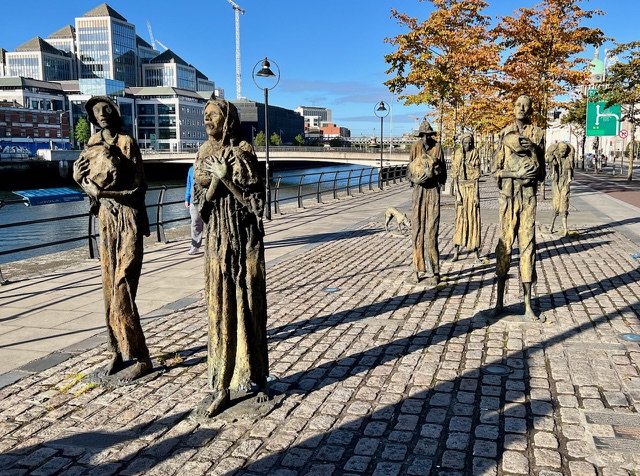
Our postcard from Dublin — The Famine Sculptures

Ireland was devastated by the great potato famine in the 1800’s. Potatoes had become a diet mainstay, and a source of income as well. When a blight destroyed the crops in 1845 they assumed it was a one-year problem, and “weathered the storm”. When the blight also ruined the next year’s crop it became devastating. Over four years at least one million died from starvation, and many more departed for other countries. Many landed in Boston, for example. The population of Ireland during that period dropped from 8 million to 4 million.

Those deciding to leave everything for a new country would go to the dockery area of Dublin to seek space on a boat. Often they waited too long, and many did not survive. The Famine Sculptures graphically capture their plight along the riverside. The man in the back right lost his family except his daughter, who was very weak from hunger. He carried her to the food line, but arrived too late the first day. The food was all gone. He arrived earlier the second day, yet was still too late. The third day he arrived in time to get her food. When he laid her down to feed her she was already dead. In a bit of morbid humor, the dog in the left rear was there to make those who died his own meal. So very touching.

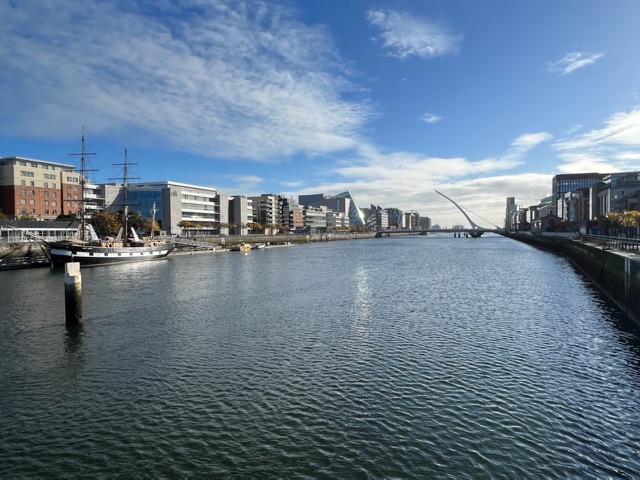
The ship pictured on the far left was one of the boats used. Many perished on these boats, from disease and famine. For some reason this boat never lost anyone on its voyages.

Our postcard from London — Bitten by Brexit

We got our first personal taste of an impact of Brexit upon arriving in London. Everyone on the ship, even those not going ashore, had to go through immigration because they are no longer part of the EU. We were taking the train into London to meet a good friend for the day after the ship docked at 8 am. There was a delay in clearing the ship, then of course the immigration. Apparently the port authorities did not have the immigration officials in place when needed. A huge line formed, as you can see from the pictures. The ship did not do a good job of managing the queue, so people who felt they were entitled to not be in the big line found other ways to cut in — and not a single ship person was around to manage it. It took an hour from the time we joined this line — and as you can imagine many people were not happy.

The real point is that anyone entering or leaving the UK now has to go through this. And at least there was no luggage involved.

Long immigration line on the cruise ship at the London port