Our first postcard from Sicily

Our good weather bubble finally burst — for just a day. After no rain at all since May Siracusa got so much in a few hours that streets were flooding up to hubcaps. 1/4 of their annual average.

We have been intrigued by Sicily for a long time — for its food, wine and folklore. Now that we are here we are learning and experiencing a lot, and really enjoying it. Our twelve days here is taking us around the entire island, and we have traversed a lot of “country roads”.

  • It has been inhabited since 12,000 BC, and around 750 BC was host to Phoenician and Greek colonies who left behind a wealth of archaeological treasures to explore.
  • Sicily has been part of Italy since the unification in 1860. Like Scotland in the U.K., they have their own Parliament which has limited powers within the constitution.
  • Over the years Sicily has been ruled by Pagans, Christians, Byzantines and Normans among others — and now Italy. Churches reflect all of those periods and influences.
  • Their farmland is rich, enabling amazing food. 40 million olive trees with only 6 million residents. After enjoying it for more than a month now all of our future olive oil will hopefully come from Puglia or Sicily.
  • The Mafia is real and part of daily life. We learned that its origin dates back several hundred years. Wealthy yet absentee landowners paid small “militia” to protect their properties. When Italy was unified there were only a few hundred people providing all of the services to remote Sicily, and the Mafia flourished by providing protection and services. Today many Mafioso have become wealthy and are now even part of the governance structure. Let’s just say that they take good care of their own.
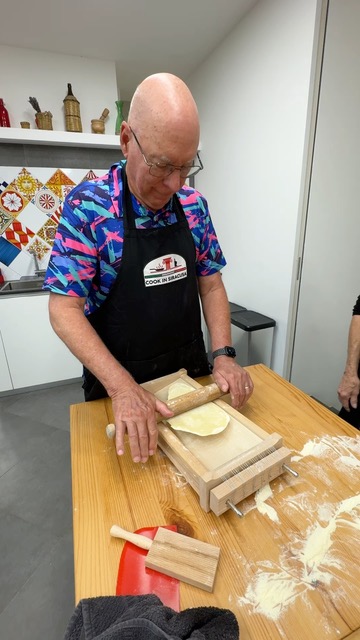
  • Pasta is really really good. So is gelato. We learned to make a number of kinds of pasta in a cooking school and got to utilize a pasta guitar. It is shown in the photo below. One puts the sheet of pasta on it, rolls it across the “guitar” wires, then strums the wire and the pasta separates into linguine. Big fun!

The next postcard will be the last from this trip. Hope everyone at home is doing well.
Our postcard from Portofino

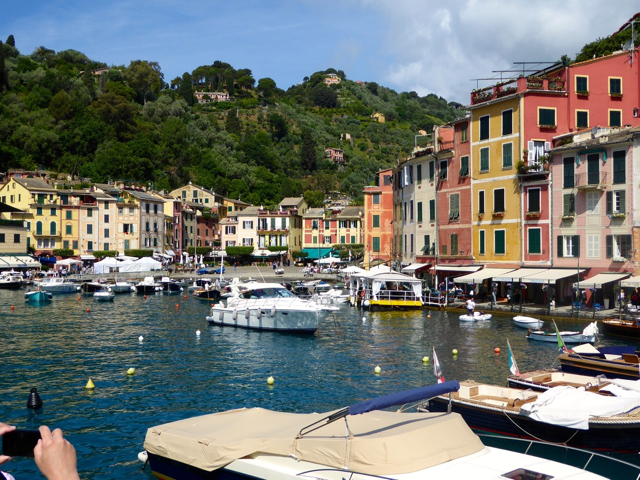
Portofino is another of those stunning Italian coastal villages. This time we did more than stroll and shopping. A very interesting tour revealed some facts that we felt worth sharing.

Most of the buildings along the water date back to the 1200’s. Originally they were one very small room built out of stone. Then a second story was added, then a third, etc. Because the rooms were so small there was no place for stairs, so ladders were used to get up and down.

Somewhere along the way extra space was added to the back side, along with stairs. Today the cost of these places is 30,000 Euros per square meter — roughly 3.5 feet square. A single window facing the water adds 500,000 Euros to the price. At that price most people just own one level.

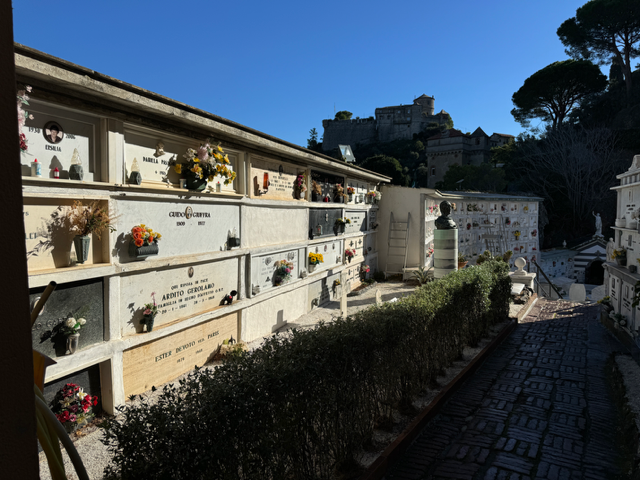
Another interesting fact is that Napoleon introduced quite a number of different practices. One involved burials. The very wealthy could buy a plot and build a mausoleum, or whatever they wanted on it. And since they owned it they could add on later. For the middle class he introduced the idea of “rental crypts”. A family could rent one for 10 years, and renew the lease twice. Then the remains had to be moved, at that point perhaps as ashes. The idea was to give dignity to the deceased, yet realize that after 30 years no one was likely still visiting. In a place like Portofino, where space is so precious, it makes a lot of sense. As you can see in this photo, there are several slots waiting for new arrivals.

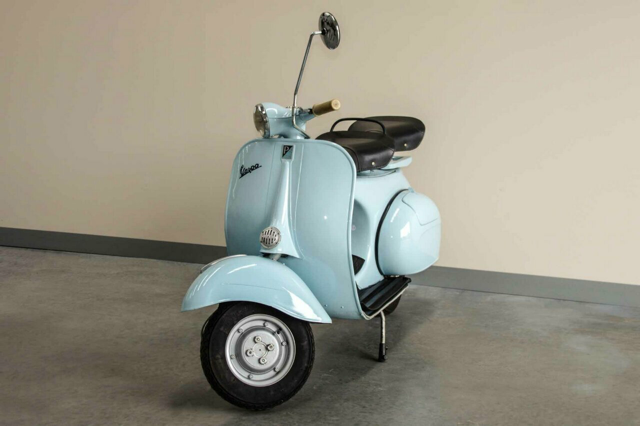
The final fact involved the legendary Vespa motor scooter. An Italian industrialist had quite a success with his business. After the war he decided that he wanted to do something good for society. In the post-war time scooters had become popular, yet ladies had to ride side saddle for modesty. They wore skirts or dresses (long before skorts emerged). The two wings on the colorful Vespa were designed to let the ladies drive them in skirts or dresses, and created a lot of mobility freedom. Good for him!

Our postcard from Positano

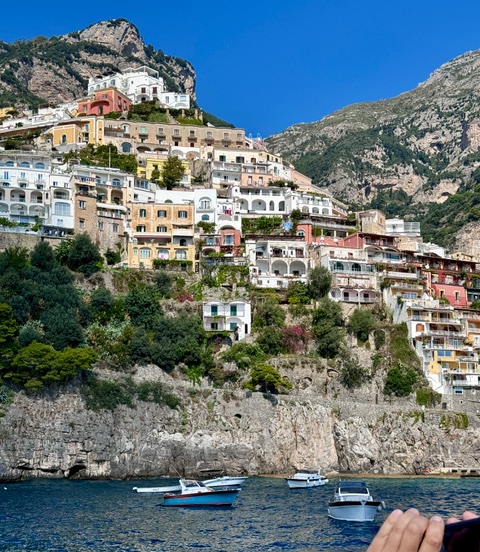
Positano is one of those postcard Italian coastal villages. The bowl shape and colorful buildings are so picturesque.

We first visited Positano in 2009, staying then for ten days. 15 years later the only change is a lot more people.

After a history as a trade center dating back thousands of years Positano transformed itself into a tourist mecca in the 1950’s. Author John Steinbeck helped, famously describing it as a “dream place” in a published article. Other authors, then lots of famous people, followed.

Positano still has a huge number of steps, and no elevators. We rented a very Italian villa with a stunning location. It is the pink and white villa right in the middle of this photo to the right of the larger mustard colored one.

Our villa was 256 steps from the beach, and 92 steps up to the main road. A round trip to the shops and restaurants involved at least 400 steps plus a fair amount of sharply uphill walking. Easy going down, bit of a chug going up. The villa spanned three stories, with the living level on the bottom floor. Our other couple commented that they registered 16 flights without leaving the villa on the day we “stayed in” just to enjoy it.

The lesson for this postcard is travel while your hips, knees, back and feet are good. We had a blast, and really enjoyed it all. All of the steps helped counter the always amazing Italian food. We have just met too many people that waited too long to travel, and then could not tolerate or enjoy places like this.