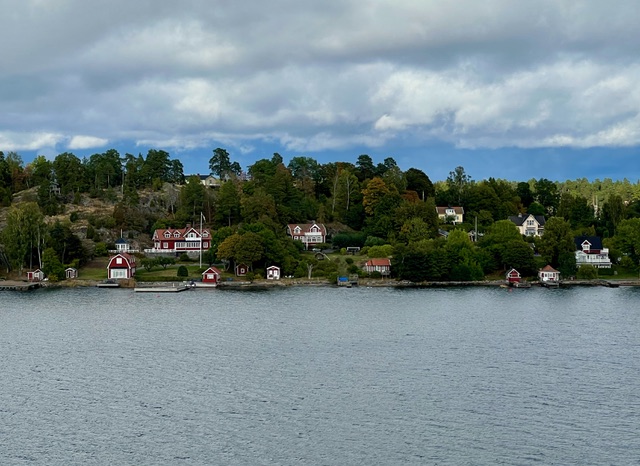
The archipelago of Stockholm is dotted with adorable red cottages and houses, and a few yellow ones.
It turns out that there is a bit of history in the red cottages and houses here. Dating back to the 800’s Sweden has had an abundance of iron ore. The residual from mining is used to make a red paint named Falu Red. It is less expensive to produce, so it became very popular.
As time passed some of the wealthy decided that the red paint also symbolized those who could not afford a different color, and they painted their houses yellow or gold to flaunt their wealth. Pretty ironic, because Falu Red also proved to have some amazing properties. Most houses in Sweden are wood because of the abundance of forests. Falu Red is permeable, meaning that it allows the wood to breathe and does not trap moisture — so it avoids rot. It also had built-in UV protection, and lasted and lasted and lasted without adding another coat and without a primer.
In the late 1500’s the Swedish government decided that the class distinction was not a good thing, and began to encourage the end of Falu Red. At the same time what is now old town in Stockholm was being developed, with stone or brick construction. A variety of blends of red and yellow became fashionable. In 1687 the Falun mine collapsed, ending copper mining there. Falu Red did not go away however. And now its many positive properties are appreciated, and luckily it has a new lease on life. Despite no mining for more than 300 years they estimate enough residual materials from the slag remaining at the mine to produce Falu Red for another 80 – 100 years.
We see Falu Red homes and cottages as a distinctive part of the charm of the Stockholm archipelago.