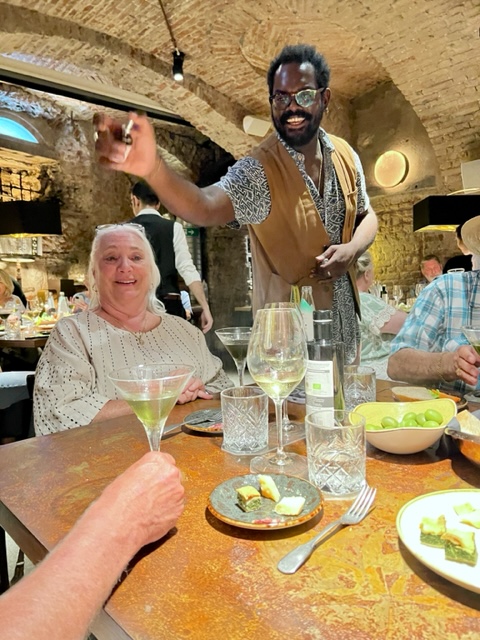
We are spending eight days in Bologna — the food capital of Italy. Sounds crazy to spend eight days in a city not named Paris or London — yet we are looking forward to it.
When in any new city we like to begin with a “lay of the land” walking tour — just to learn things and get our orientation. So off we go the first morning for a five hour walking tour. As expected, we learn a lot about the history of Bologna and a little bit about the food scene. We also learn that our apartment has a great location. It is in the middle of the old city, and everyplace (except one) we want to visit is walkable. Yet it is amazingly quiet.
The highlight became learning about the porticoes.
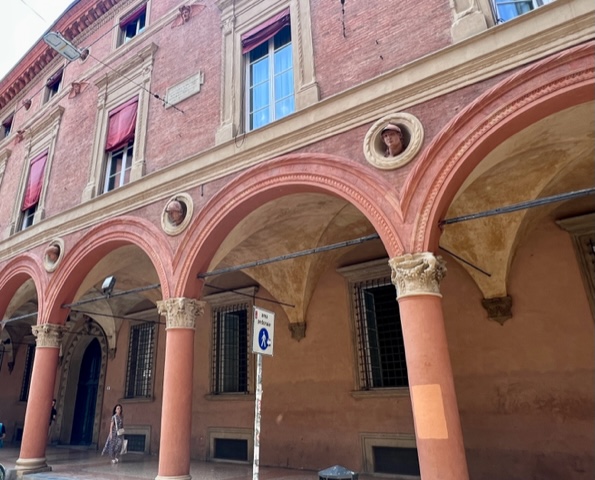
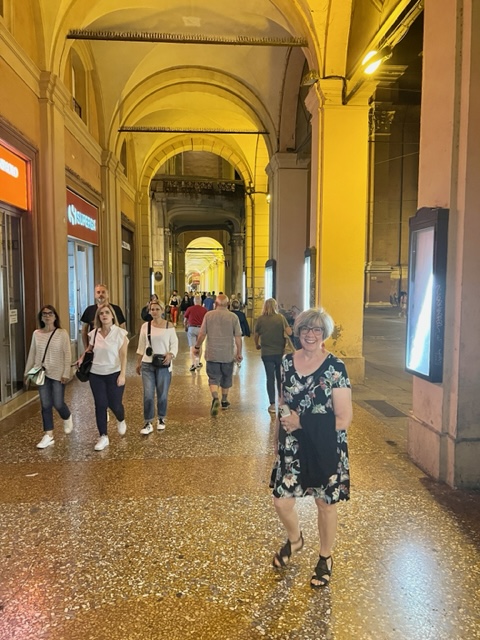
The porticoes date back to 1041, when additional housing was needed. Today no city in the world has more porticoes, and the porticoes of Bologna enjoy UNESCO World Heritage status. They are everywhere, and the locals joke that one does not need an umbrella. You will only get wet when crossing the street — and they also provide wonderful shade.
The porticoes have always belonged to the owner of the building. They are spacious, and beautiful. Originally the owner was allowed to drive his horse and carriage on his portico. They were held up by wooden beams preserved with cow urine. When the wood began to deteriorate after hundreds of years it was surrounded by brick or stone, then replaced. Access had to be guaranteed. A minimum height was decreed, tall enough for a horse and rider or carriage. The portico floor has to be the same material used for the interior ground floor, and most are mosaics. A number have frescoes in the arches and even on the ceilings. Today it is the building owner’s responsibility to leave them clean at sunset every day, and also to promptly make any repairs. They are revered by the public, and seem to escape graffiti and other nuisances.
Our “home” is a lovely two-bedroom apartment with a fabulous and large outdoor patio surrounded by flowering bushes. Very quiet, has an elevator and A/C, and a washer/dryer. Our stay here marks our departure from our tour group, so we are now on our own. We have a rental car and a private garage.