The next idea when the Pyramids were too easy to spot and rob were tombs. They were built into the hills, with the idea of hiding them under sand and stone that looked like everywhere else to avoid having them robbed.
Tombs were only for the afterlife. Now Queens and Nobles could also have them – just with fewer rooms. So far they have found 80 tombs in the Valley of the Queens. Kings still had many rooms on various levels. When the royal died they would stock the tomb with favorite jewelry, oils, clothes, furniture for the afterlife, then place the mummy in the tomb and close it up. The mummification process took 40 – 70 days, to prepare the organs (each organ placed in alabaster in the tomb) and to wrap.
This idea did not work much better. With one exception all of the tombs were still raided during the B.C. era. Why, we wonder? Our guide’s theory is that it was an inside job. Those building or moving things to the tombs tipped off the robbers.
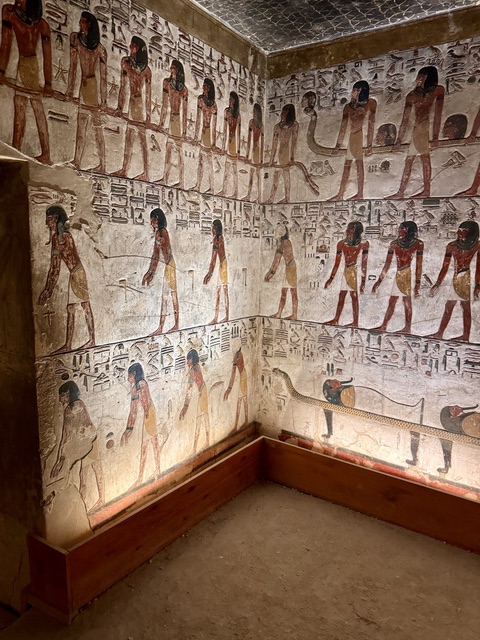
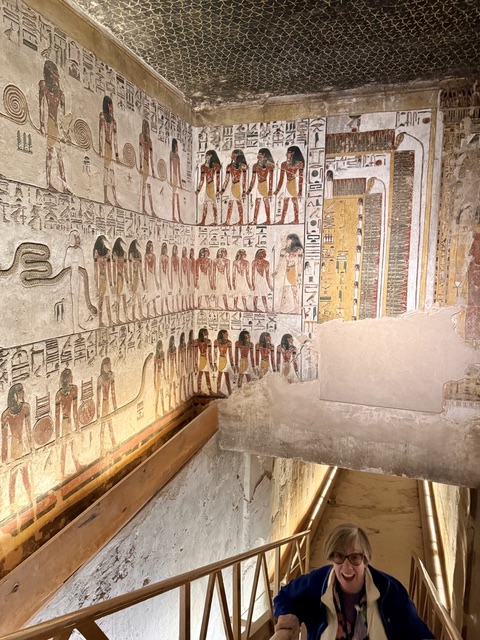
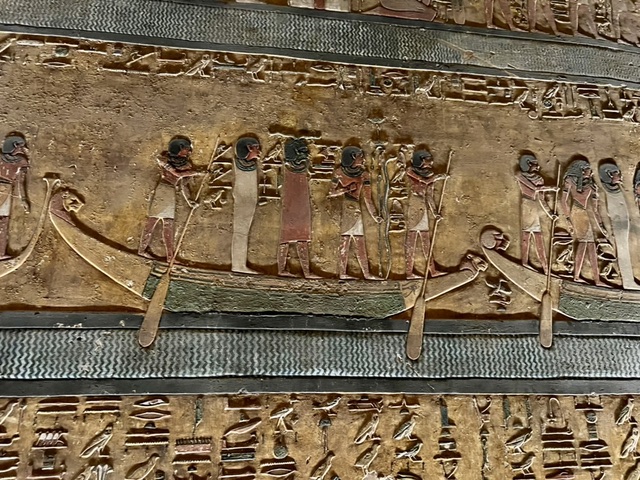
The best-preserved tomb is Seti I. It is one of the longest tombs at 450 feet, and also one of the deepest at 200 feet. Comprised of 11 chambers, and built between 1290 and 1279 BCE. These tombs have been “dusted off”, yet no other restoration. This one is truly amazing for its colors. All of the tombs are filled with carvings like this. It is hard to imagine this kind of preservation after 2600 years, with no a/c or other protections. Today the ticket to view it is very expensive — their way to limit the crowds in the interest of preservation.
The most famous tomb is of course King Tut. It is the one exception to being robbed. He was not a particularly famous or strong king, and died unexpectedly at age 19. As a result, they did not have time to finish his tomb and it was only one room. Perhaps because it was so small another tomb was later built right over it. When they robbed the one above no one thought there might be another one right below until Howard Carter launched and funded an expedition to locate it. It was actually discovered by accident, when a donkey was bringing water for the archeologists. The donkey’s leg sunk into a hole, and that is how they found it in 1922.
On the other hand Ramses II, one of the most powerful kings who reigned for more than 60 years, made a strategic mistake. His tomb was too close to the valley floor and was badly damaged by moisture, probably from flooding from the Nile river.

